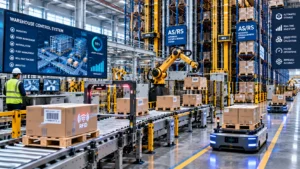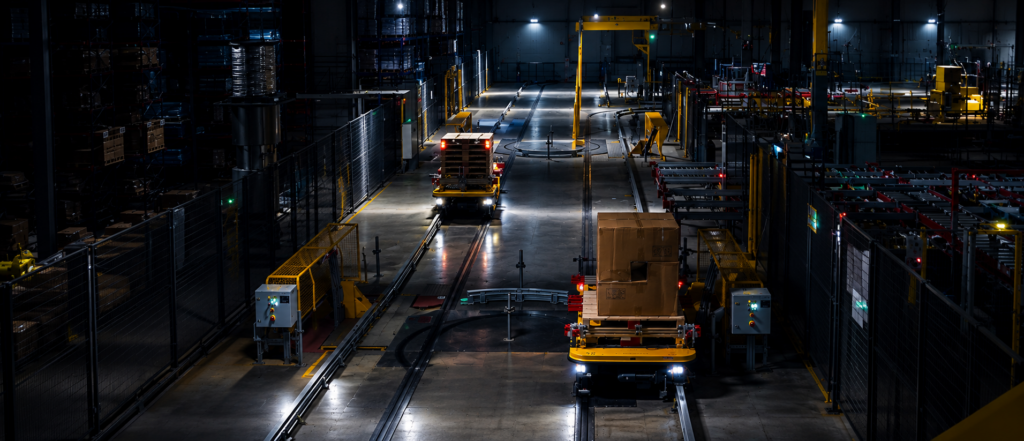
Picture your warehouse at 2 a.m. The lights are off, no forklifts are on the floor, and orders are still moving toward the dock. That’s the idea behind a dark warehouse, and it’s no longer just a concept you see on a trade show floor.
Is your team struggling to staff second and third shifts? Are you running out of floor space while order volumes keep climbing? Those pressures are exactly why operations managers, plant managers, and supply chain leaders are asking what lights-out warehousing could mean for their facilities.
At Bradford Systems Corporation (BSC), we help industrial facilities plan, specify, and install storage and automation systems every day. In this first post of our three-part series, we’ll explain what a dark warehouse is, how it differs from similar terms, why it’s getting so much attention, and where it does (and doesn’t) make sense.
What Is a Dark Warehouse?

In practice, “dark” is a spectrum, not an on/off switch. Industry analysts note that a facility moving full pallets in and out is far easier to run lights-out than one picking individual items, where product variety and exceptions multiply quickly. Most real-world facilities also keep safety and maintenance lighting, and many run fully automated zones right next to areas where people still work.
Dark Warehouse vs. Dark Store vs. Automated Warehouse
These terms often get mixed up, so here’s a quick breakdown:
- Dark warehouse (lights-out warehouse): Describes the level of automation inside a facility. Equipment and software handle storage and movement with minimal on-site staff.
- Dark store: A retail-style location that’s closed to walk-in shoppers and used only to fulfill online orders, typically placed close to customers for fast delivery. Many dark stores still rely on people to pick orders.
- Automated warehouse: A broader term for any facility using automation, from a single vertical lift module to a fully integrated system. Every dark warehouse is an automated warehouse, but most automated warehouses aren’t fully dark.

Why Lights-Out Warehousing Is Getting So Much Attention
Labor is the biggest driver. In the 2025 MHI Annual Industry Report, produced by MHI and Deloitte from a survey of more than 700 manufacturing and supply chain leaders, workforce and talent shortages ranked among the top three trends affecting supply chains, cited by 35% of respondents.
The same report found that supply chain leaders expect adoption of robotics and automation to reach 83% within five years. More than half of respondents (55%) said they’re increasing their supply chain technology investments.
Space and speed matter, too. Industrial real estate is expensive, and customers expect faster, more accurate orders. Automation lets you store more in the footprint you already have and keep working through nights and weekends without adding shifts.
The Benefits of a Dark Warehouse
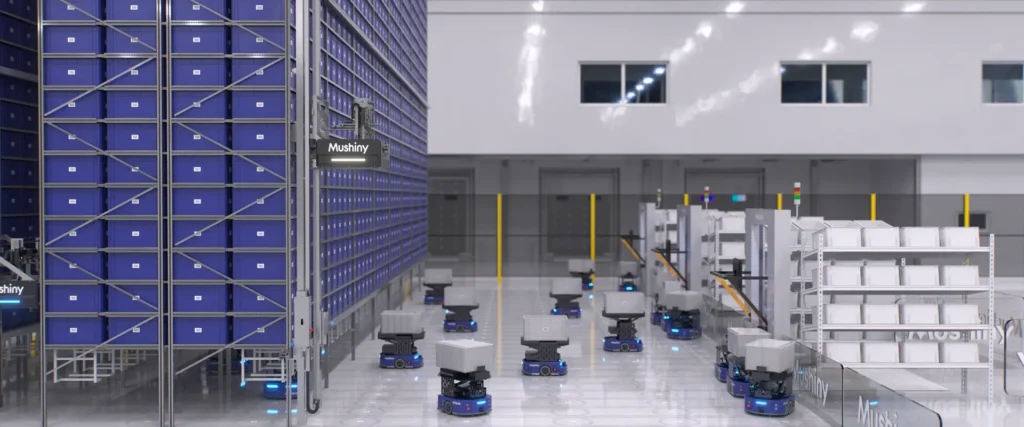
When it’s planned well, lights-out automation can transform how a facility performs:
- Round-the-clock throughput. Automated systems can keep running 24/7 without interruption.
- Higher accuracy. Software directs every retrieval, reducing the human error that leads to mis-picks and misplaced inventory.
- Better use of cubic space. Automated equipment doesn’t need aisles wide enough for people and forklifts, so storage can go higher and tighter.
- A safer workplace. Fewer people work near moving equipment, climb ladders, or reach for heavy items overhead.
- Lower energy use in storage zones. Unoccupied areas need far less lighting, and denser storage leaves less space to heat or cool.
The Realistic Limits
A fully dark building isn’t the right goal for every operation. Lights-out projects are capital-intensive, and fragile, bulky, or highly regulated items can resist full automation. Automation also works best with consistent, predictable inventory and packaging.
People don’t disappear, either. Equipment needs preventive maintenance, and someone has to handle exceptions like a damaged carton or a jammed conveyor. Connected systems also need protection: the MHI report lists cybersecurity and data security as a top technology trend shaping supply chains. That’s why the most successful facilities match automation to the job instead of chasing a fully dark building on day one.