You’ve seen what a dark warehouse is and the technology that powers it. Now comes the real question: where do you actually start?
The good news is that you don’t need a new building or a massive one-time investment. Most of the industrial facilities we work with at Bradford Systems Corporation (BSC) move toward lights-out operations one zone at a time, automating first where labor, space, or accuracy problems hurt the most. Here’s the phased approach we recommend.
Step 1: Start With Your Data
Before choosing any equipment, get a clear picture of how your facility really works. Look at:
- Inventory profile: How many SKUs (stock keeping units) you carry, their sizes and weights, and which ones move fastest.
- Order profile: Whether you ship full pallets, cases, or individual items, and how volume swings by season.
- Labor and travel time: Where your team spends the most hours walking, searching, and reaching.
- Space use: How much of your building’s height you’re actually using.
This groundwork pays off later. Supply chain leaders surveyed for the 2025 MHI Annual Industry Report named the lack of accurate, real-time data as an ongoing barrier to digitizing their operations.
Step 2: Make Every Cubic Foot Count
Automation works best when your storage footprint is already efficient. Start by recovering wasted space.
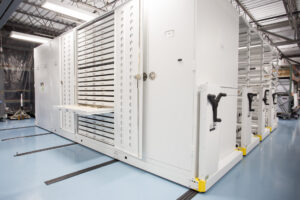
Spacesaver’s ActivRAC heavy-duty mobile racking mounts racks on powered carriages that open the aisle you need on demand, eliminating fixed aisles. It’s well suited to manufacturing, warehousing, and cold storage, where every cubic foot is expensive to keep cold, and its carriages are rated for 3,000 to 30,000 lbs. For static zones, industrial warehouse racking and mezzanines put unused vertical space to work.

Step 3: Add Goods-to-Person Storage
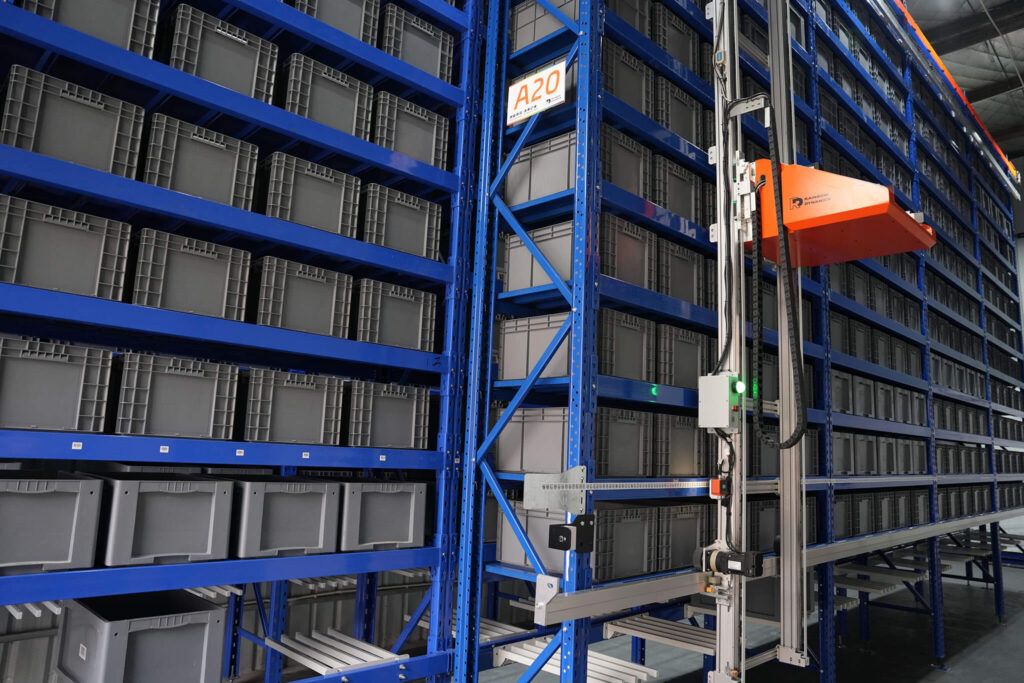
For small parts, tools, and spare components, Modula Vertical Lift Modules (VLMs) are often the most practical first automation project. A VLM stores inventory on trays inside an enclosed tower and delivers the right tray to your operator at an ergonomic picking bay, so no one climbs, searches, or walks aisles.
Modula reports its VLMs can save up to 90% of floor space. Just as important for a phased plan, the Modula Lift can integrate with robots, conveyors, and picking stations, so the VLM you install today can become part of a larger automated system later. You can tailor each unit with picking aids and software integrations
 .
Not sure which zone to automate first? Our team can walk your facility, review your inventory and order data, and map out a phased plan that fits your budget. Talk to a BSC automation specialist →
Step 4: Automate Pallet Movement
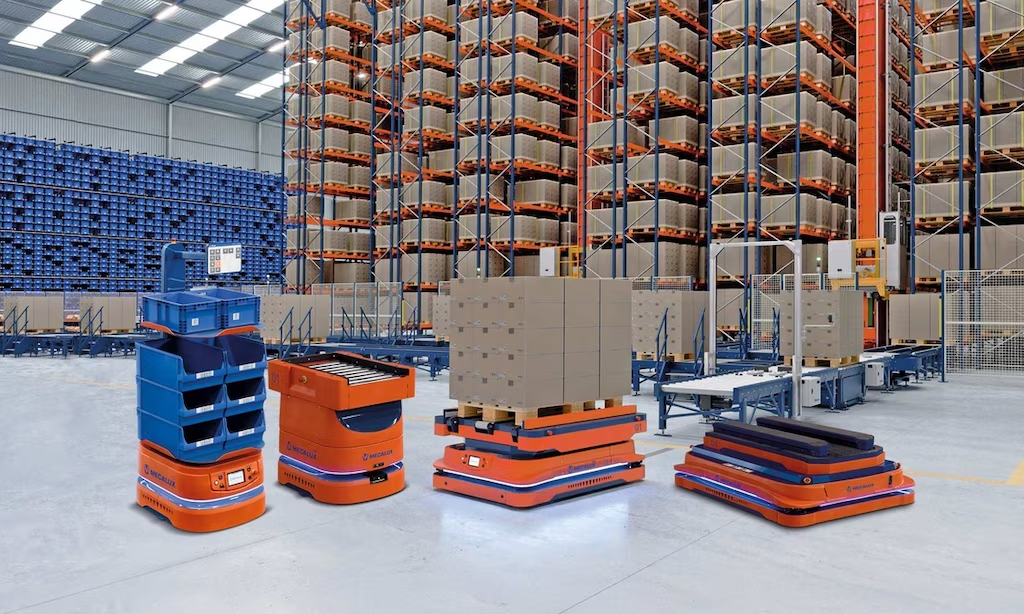
Pallet-level operations are usually the easiest place to go fully lights-out, because loads are uniform and predictable. Our industrial automation solutions include ASRS pallet shuttles, AGVs, AMRs, and conveyor systems.
If you’re piloting automated vehicles, AMRs are often easier to start with. Unlike AGVs, they don’t require extensive infrastructure installation, so you can test one route and expand the fleet as you see results.
Step 5: Design Safety In From Day One
Every partially automated facility needs clear boundaries between equipment zones and people zones. Two standards are worth knowing:
- OSHA machine guarding. Under 29 CFR 1910.212, employers must provide one or more methods of machine guarding to protect operators and other employees in the machine area. Barrier guards are among the methods OSHA lists.
- Mobile robot safety. The ANSI/A3 R15.08-2 standard covers integrating AMRs into a site and requires a risk assessment before deployment.
Wire cages and machine guarding create physical barriers around robotic and automated zones, while our industrial safety equipment protects people and racking where forklifts and workers still operate. Where your team meets the automation, ergonomic workstations keep picking and packing comfortable.

Step 6: Integrate, Train, and Maintain
Each new system should connect to your WMS or ERP so inventory stays accurate across the whole facility. Train your team on monitoring dashboards and handling exceptions, and build preventive maintenance into your schedule from the start. Finally, bring your IT team in early: the MHI report lists cybersecurity as a top technology trend shaping supply chains.
Frequently Asked Questions About Automating a Warehouse
Your Path to Lights-Out Operations Starts With One Zone
A fully dark warehouse is a destination, not a starting point. By working step by step, from data to density to goods-to-person storage to automated movement, you get results at every phase while building toward a facility that can run around the clock.
As a full-service storage provider, Bradford Systems partners with industrial facilities from planning and design through installation. Contact our team to map out your first phase, or explore our full range of industrial storage solutions.
Sources
- MHI and Deloitte. New MHI and Deloitte Report Focuses on Orchestrating End-to-End Digital Supply Chain Solutions (2025 MHI Annual Industry Report press release via Business Wire), March 19, 2025.
- Jeff Shepard, DigiKey, via IoT Insider. Safely and efficiently integrating AMRs into Industry 4.0, May 24, 2024.
- Occupational Safety and Health Administration. 29 CFR 1910.212, General requirements for all machines.